
 Miss Cholmondeley, 1804, hand-coloured etching by Charles Turner, 11”x 14”, after a painting by John Hoppner.
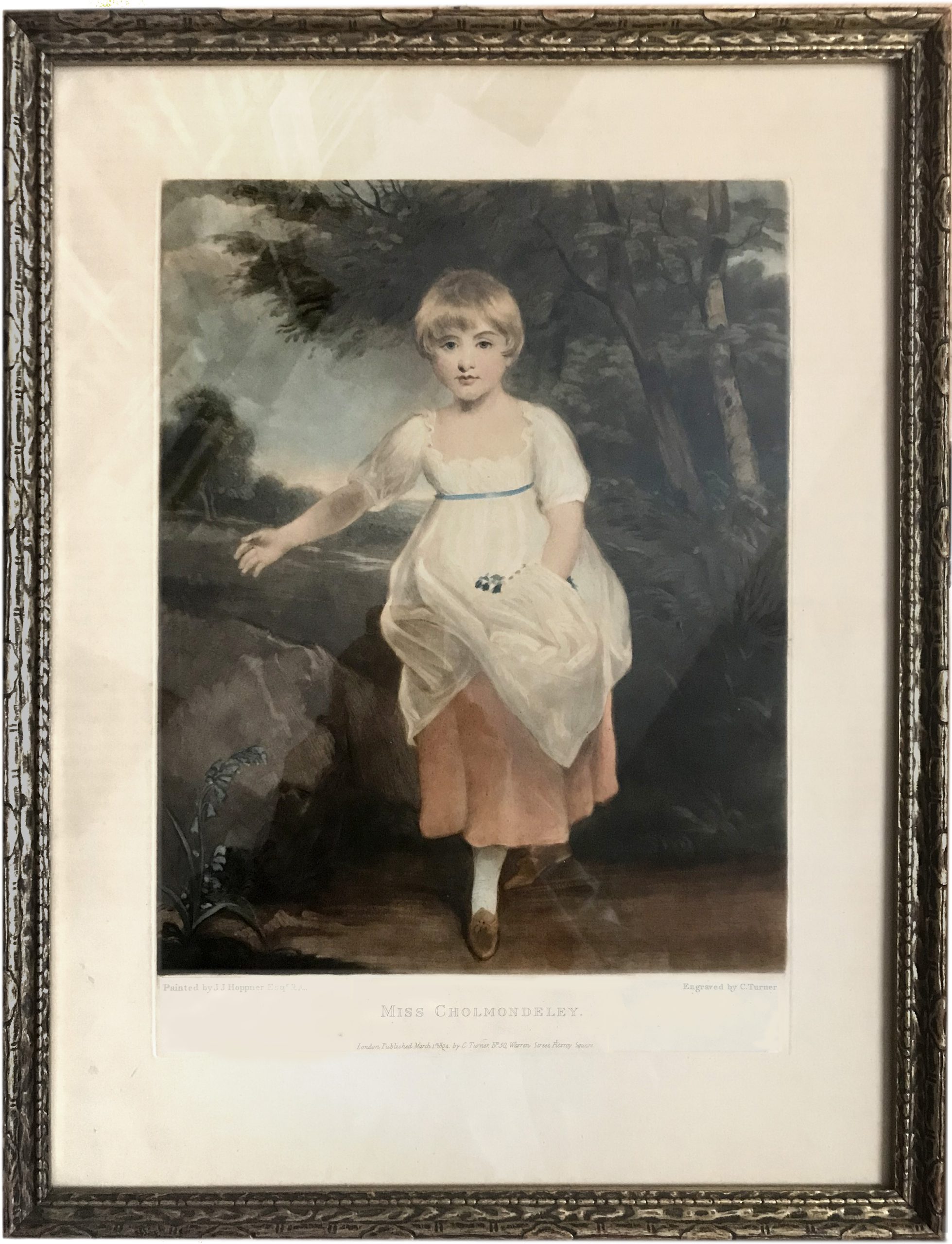 Miss Cholmondeley, 1804, hand-coloured etching by Charles Turner, 11”x 14”, after a painting by John Hoppner.
WHO WAS HARRIET?
On finding an old print of young Miss Cholmondeley gathering bluebells
It’s curiosity that makes me a collector, so naturally I’m attracted to curious things—artefacts that promise, once investigated, to reveal marvelous histories and novel meanings. But what are these promises of significance, these clues?
Browsing through an antique mall off Highway 11 last year, north of Orillia, I found a nice old portrait for $35. The subject’s name intrigued me, because it’s one of those strange words that doesn’t sound remotely like it looks.
In Schott’s Original Miscellany (2002), Ben Schott lists forty-two “Curious surname pronunciations,” e.g.,
Althorp: Althrup, Altrup, Atrup
Auchinlech: Af’lek
Beauchamp: Beacham
…and so on.
These are old names from a time before standardized spelling, ancient enough for common pronunciation to have left behind, possessing the cachet of venerable lineage. The phenomenon was parodied by the British sitcom Keeping Up Appearances, in the character of Hyacinthe Bucket (pronounced “Boo-kay”).
Harriet’s father George, 1st Marquess of Cholmondeley (“Chumly”), was an aristocrat and member of England’s smart set in the late 18th century, familiar with the demi-monde on both sides of the Channel. He was the lover and protector of Grace Dalrymple Elliott, courtesan, secret agent and author of the primary text Journal of my Life During the French Revolution, and the partner for several years of another courtesan, Madame de Saint-Albin, a great French beauty—Harriet was their child, born shortly before his marriage to Georgiana, daughter of the Duke of Ancaster and Kesteven. The illegitimate child was raised in the Cholmondely household, a not unusual practice at the time, amongst the upper class.
The print was made by Charles Turner in 1804, after a painting by John Hoppner of about six or seven years earlier. The market that warranted Turner’s productization of a family portrait was stimulated by celebrity and aristocracy, as well as the appeal of pictures of childhood innocence, a fashion much popularized by his exemplar Joshua Reynolds, first president of the Royal Academy. Also in 1804, the Cholmondeleys rebuilt the family seat in Cheshire in the manner of a medieval castle, with round corner towers and a crenellated silhouette—neo-gothic, the cutting edge of style.
In addition to the notoriety of her parentage, Harriet is an attractive child and the painting is full of charm as she poses while gathering bluebells, a flower not without symbolism. The print is an etching combining aquatint with delicate linework that provides some shading and detail. The colour was done by brush after printing, with water-based paint. At least four artists were involved in the production of this work: Hoppner and assistant(s) at his studio, perhaps even separate painters for costume and scenery, then Turner and his watercolourist(s), and possibly other artisans to ink and pull the print. Hairstylist and dressmaker contributed too, with Harriet’s gamine hairdo and fashionably neoclassical outfit—note the high waistline. In concept, the image represents a progressive ideal close to the heart of the Romantic movement: the liberation of the individual, in free-and-easy clothing, close to nature, away from the strictures of civilization.
Envoi
“Maybe you’ll find direction, around some corner where it’s been waiting to meet you.”
—Box of Rain, Robert Hunter [1970]
You can’t know what is curious until you find it, but there are certain interests one develops which one recognizes in the wild, and this print hit several of those buttons.
I trust serendipity to lead the way, and do my best to follow, primarily by frequent and widespread patronizing of thrift stores, flea markets, used book stores and antique shops. This is both enjoyable and affordable, because these are museums where one can pick up and examine the exhibits without admittance fee. Who knows what discarded wonders will find their way to such bountiful emporia, available to purchase for a pittance? And then, oh!—the stories they tell, with a little help from Google and Wikipedia. ●