

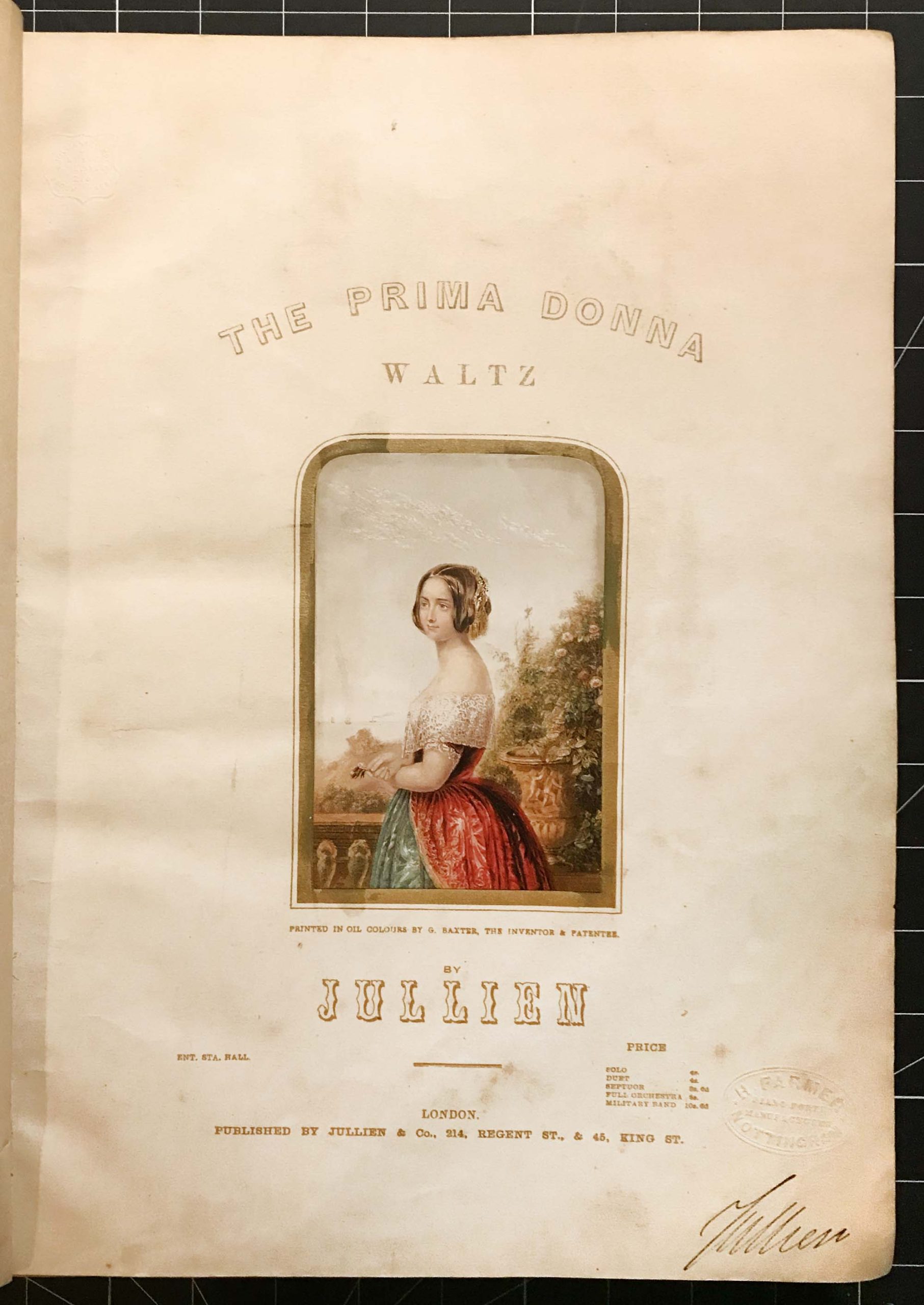
Sheet music cover of The Prima Donna, composed and published by Jullien in 1851, and embellished with The Bride by George Baxter. 10” x 13¾”.
PLAYLIST 1851
2. The Prima Donna
How hyperscalers George Baxter and Louis-Antoine Jullien developed mass consumer culture in the early Victorian era
Life ain’t fair, and that’s the law. Zipf’s Law, in fact, which states that success in the mass markets of popular culture is grossly disproportionate, subject to a power curve that positions the median far below the mean, while raising the occasional superstar. Therefore, if the question “Who is the Prima Donna?” had been asked anywhere in Europe or North America in 1851, there would have been only one answer, “Jenny Lind.”
Everywhere the Swedish Nightingale performed, Lindmania ensued. Queen Victoria was a huge fan, in the royal box of Her Majesty’s Theatre for every one of the sixteen performances of Lind’s 1847 London debut, then entertaining Ms Lind at her summer palace, Osborne House. Jenny turned 27 that year, Victoria 28. You might say the entertainment was mutual, between those two exceedingly wholesome fashion icons.
But that’s not Ms Lind on this music cover, in fact, the lady bears more than a passing resemblance to the Queen!
Here’s why: it’s all because of Jullien, the composer and publisher of the waltz.
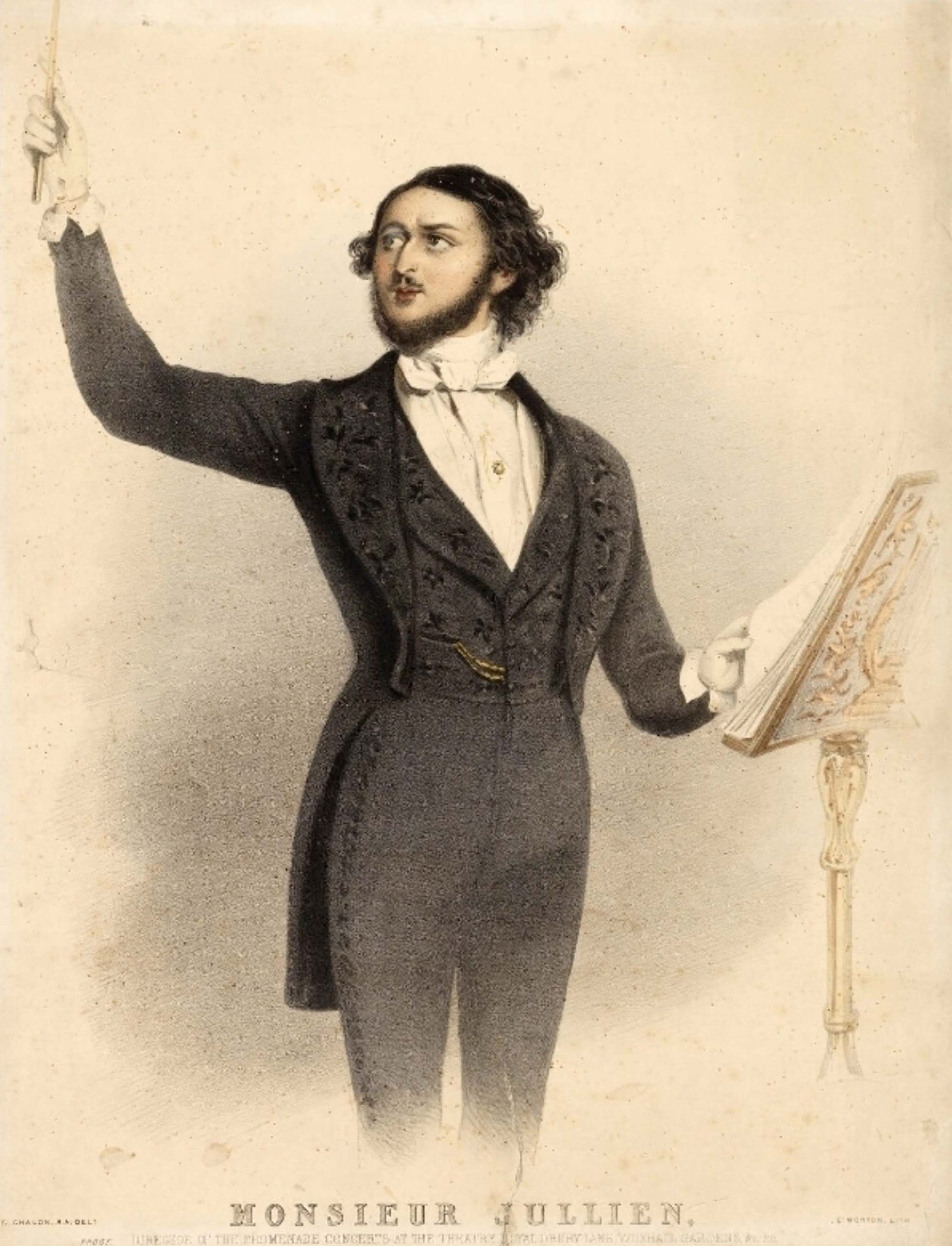
The exemplary Monsieur Jullien
Louis-Antoine Jullien was a fabulous French musico who burst upon the English capital in 1838, fleeing from creditors and assassins acquired whilst conducting at the infamous Café Turc pleasure gardens in Paris. Flamboyant, grandiose and notorious, Jullien was the first rock star conductor, transforming the previous role of modest orchestral director into a cult figure—a charismatic maestro, manifesting a mesmerizing, animated, eye-popping expression of the score to both galvanize his players and thoroughly beethovenize the audience. Dressed to the dazzling nines, he was as much a dandy as contemporaries Boz (author and activist Charles Dickens) and Dizzy (author and Prime Minister Benjamin Disraeli).
He was “The Mons,” thus punned by satirical Punch magazine—refering to the self-styled “Mons. Jullien” with his “Concertes Monstres,” and how any Englishman of the day might mock those demme Frenchies with their funny old parlez-vous, pronouncing “Mon-sewer.” The butt of such wit was also the sans français music-goers who constituted the bulk of Jullien’s popular audience; and perhaps too, in self-deprecation, those clever folk at Punch for whom Jullien was a guilty pleasure.
Inimitable performer that he was, Jullien was so much more—an impresario who conceptualized and produced magnificent, exotic, immersive spectacles in which he took centre stage, exploiting the cachet that French musicians enjoyed in England, the wealthiest nation, where the public turned a deaf ear to home grown talent, prefering to import the best from abroad. Not to say that Jullien avoided local virtuosi, for although he scoured the continent for top soloists, Britons featured prominently as such and comprised the bulk of his gigantic orchestras, bands and choruses.
Jullien was a multi-disciplinary threat. His venues were well appointed with carpets, fountains, and chandeliers, and furnished with elaborate botanical displays courtesy of Mme Jullien, a florist who appeared nightly at her husband’s concerts, at her famous flower stall. Typical of his productions, The Destruction of Pompeii, in the 1853 concert season, featured pyrotechnics, stagecraft, and deafening sound effects. Jullien favoured the extreme—the firing of cannons, a specialité.
Virtual reality was familiar to early 19th century London audiences at Marie Tussaud’s wax museum with its Chamber of Horrors, and the several dioramas in the city, notably the Colosseum and that of Daguerre at Regent’s Park. Jullien was in the zone.
Behind the larger-than-life character he fashioned for the marketplace was a serious artist, bringing promenade concerts indoors from the pleasure gardens, and popularizing Mendelssohn and Beethoven. He was a fearless multi-instrumentalist, well respected by musicians; Herman Koenig, for instance, cornet virtuoso, was one of several who played in his orchestras throughout the ’40s and ’50s. And Jullien was a popular composer of dance music to boot.
He was a hit machine, playing his latest polkas and waltzes (their titles drawn from the news cycle) to captivate the crowd, then filling out the evening’s entertainment with bonbons curated from diverse genres. The flâneurs at his concerts could wander around, socialize and partake of snacks and beverages in the side aisles, free to pay attention to their tunes of choice when the occasion arose. He presided over the proceedings on a raised daïs.
The British Army Quadrille, Covent Garden, 1846. The orchestral pit protrudes from the stage, fenced off from patrons who promenade about it, the gentlemen in “stovepipe” top hats. Of note: Jullien’s throne, to the right of him; eight double basses; the orchestra augmented by four military bands; Jullien’s Big Drum, at rear.
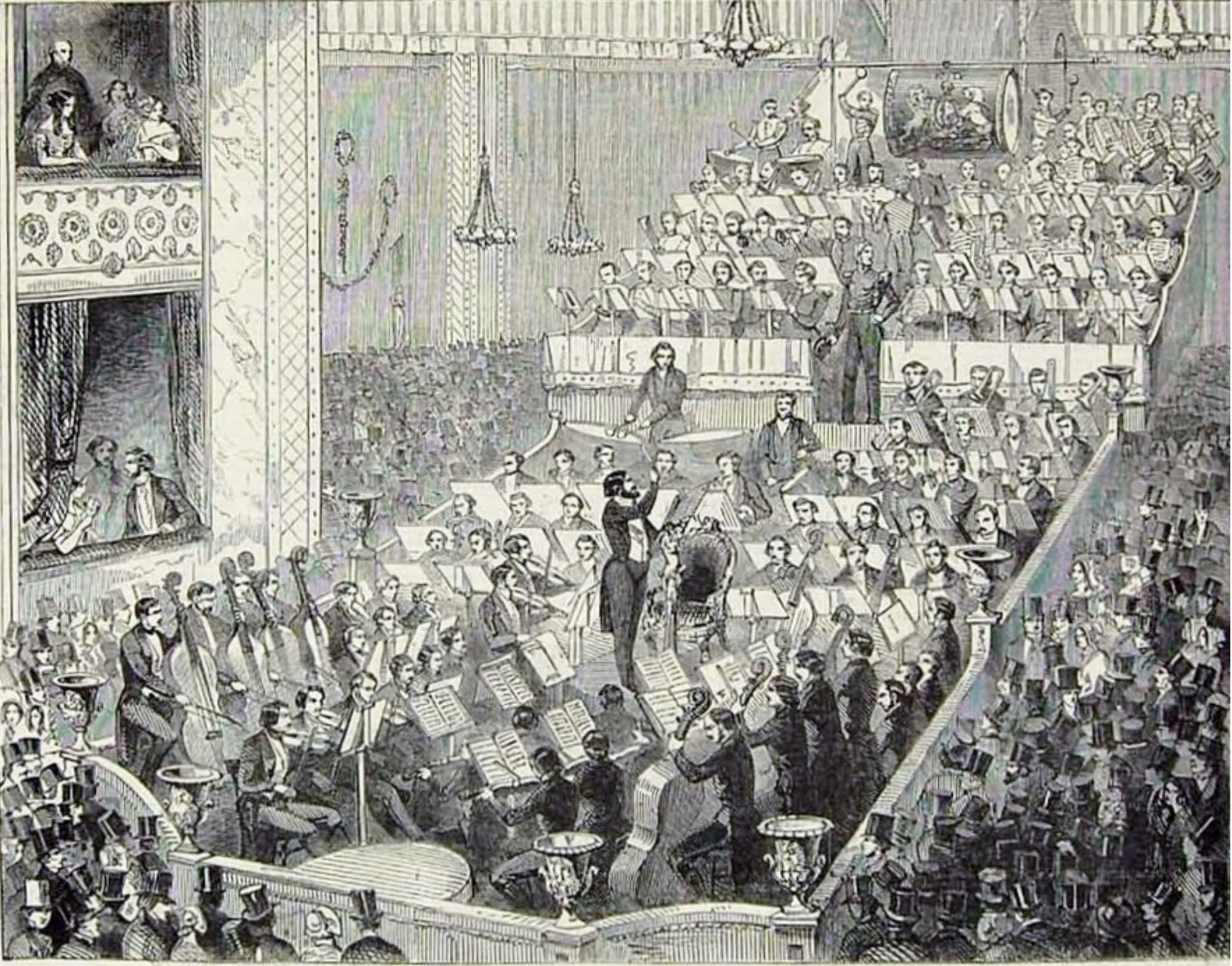 The British Army Quadrille, Covent Garden, 1846. The orchestral pit protrudes from the stage, fenced off from patrons who promenade about it, the gentlemen in “stovepipe” top hats. Of note: Jullien’s throne, to the right of him; eight double basses; the orchestra augmented by four military bands; Jullien’s Big Drum, at rear.
Ever the melodramatist, Jullien would don fresh white gloves for Beethoven, take up his best jewelled baton from a silver salver, and, following the requisite exertions, collapse at the climax, exhausted, onto an awaiting throne of velvet and gilt (see above, to his right).
The Maison Jullien on Regent Street sold musical instruments (many under his private label, new inventions introduced at his concerts) and sheet music, similarly promoted, much of it published by himself. Vertical integration was a wise move, plagiarism being widespread and music royalties yet to be invented. The Prima Donna was a big hit, with estimated sales of 100,000. So he was not without enough business smarts to buy a Belgian chateau and weather two massive bankruptcies—caused by the critical and public disaster of two hugely expensive forays into opera—during an otherwise sublime 19‑year run in London. His American tour of 1853‑4 replenished funds—and gave Barnum a few ideas.
Ultimately, Jullien’s extravagant vision exceeded his grasp. Plans to take The Hymn of Universal Harmony on a world tour precipitated a third and final dénouement, and he tragically sped from debtor’s prison to lunatic asylum and thence to the grave, burnt out at 48.
Not a man for half measures, Jullien dressed up the cover of The Prima Donna right royally. As befits a tune “Composed for the Court Balls,” it was first class all the way.
The Bride (detail). Print by George Baxter, 1850, from a painting by Fanny Corbaux. 3½”x 5”. Printed from 12 blocks.
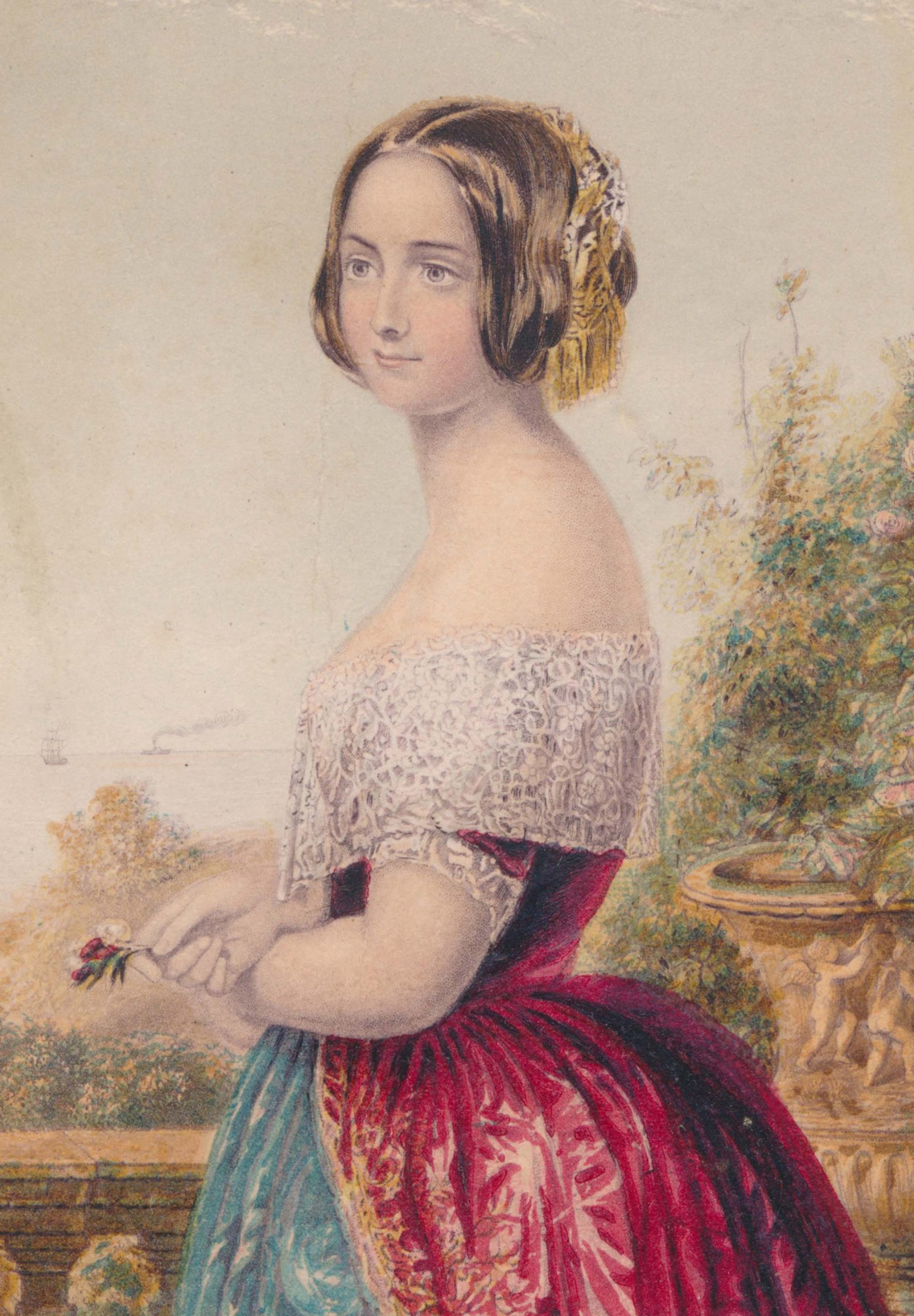 The Bride (detail). Print by George Baxter, 1850, from a painting by Fanny Corbaux. 3½”x 5”. Printed from 12 blocks.
George Baxter, colourist supreme
It cost Jullien a pretty penny for The Bride, which was printed full-colour in oils from a dozen different plates, perfectly registered, on calendered paper trimmed with a dome top and tipped onto an area of gold ink on heavy matte stock with a slight tooth—thicker than the paper it encloses, on which are nine pages of music. This print, tout seul, had been sold for 1s. 6d., while Jullien’s sheet was four shillings. About the cost of a good four-course meal at a respectable restaurant, hotel or tavern.
Jullien made a statement by securing The Bride for his waltz, Baxter being the man who had pioneered high-quality colour printing for the mass market in the 1840s—comparable in impact, one might say, to Technicolor a century later—and been invited to Buckingham Palace to be quizzed by Victoria and Albert on this latest media tech. It wasn’t just that the quality was superb, as was the value for money, but he also had an eye for the market. Although not amongst the first rank of artists—his work was somewhat stiff and laboured—Baxter had mass appeal, beguiling with glossy technique while riffing on the memes of the day. His most popular piece was, however, a transcription of Raphael’s Holy Family of 1515, clocking in at 700,000 copies. That’s a lot of passes for a 14‑block item!
Baxter had produced a charming and popular print in 1850, of the prima donna du jour, Jenny Lind, whose likeness was routinely appropriated by all and sundry to advertise their merchandise. Baxter’s classy take on this musical celebrity may well have intrigued Jullien, yet it was The Bride, also of 1850, that was to become the first of 14 Baxter prints to grace his publications.
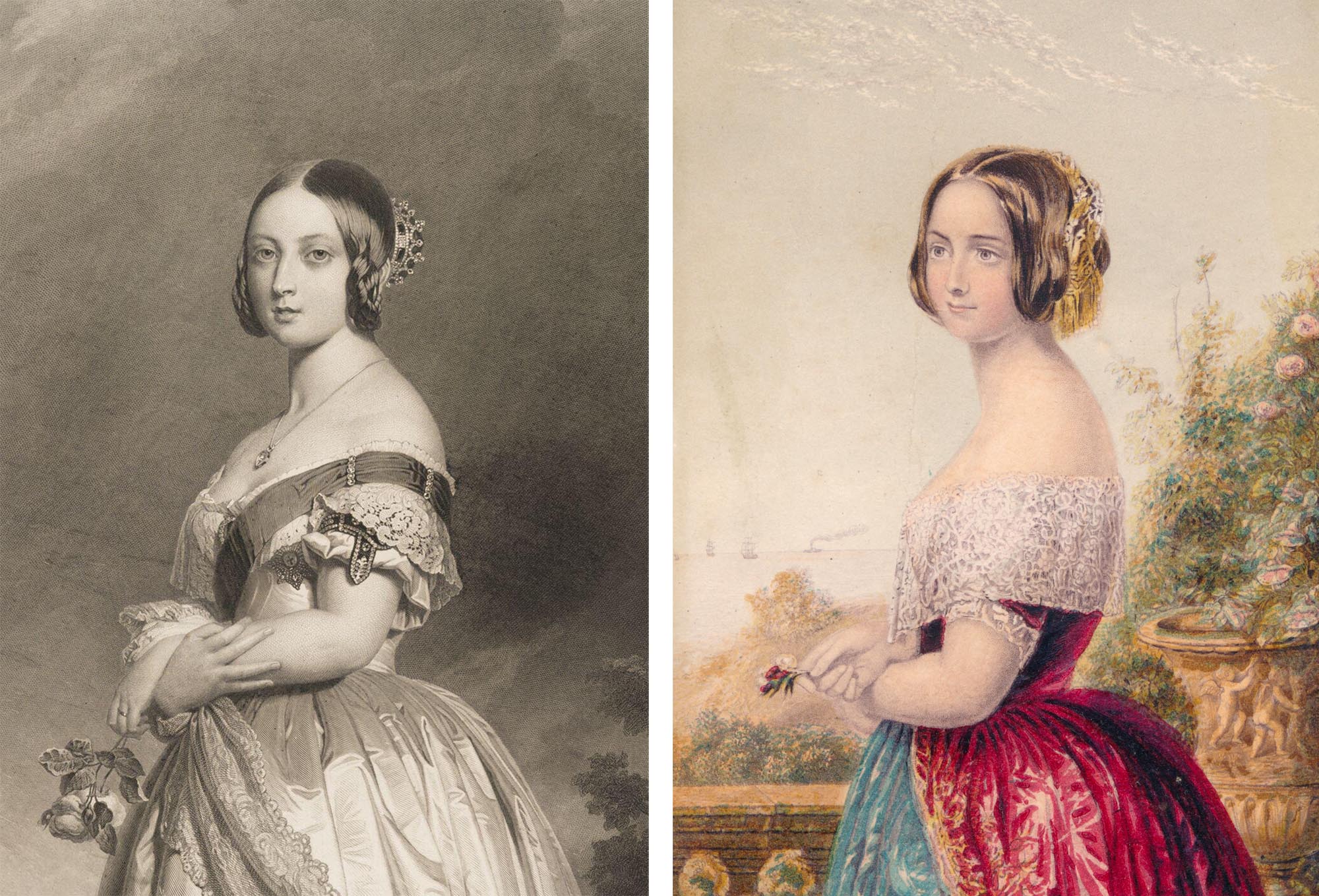
Left: Queen Victoria, engraving by François Forster after the 1846 painting by Frantz Winterhalter.
Right: The Bride, colour print by George Baxter, after a painting by Fanny Corbaux.
 Left: Queen Victoria, engraving by François Forster after the 1846 painting by Frantz Winterhalter.
Lind was blonde, but Baxter’s Bride is brown-haired and might easily be mistaken for Her Majesty, as recorded by official portraitist Frantz Winterhalter in an 1846 painting that, long before mass reproduction of photographs emerged with halftones in the 1880s, was the image by which she was best known to the world, via a monochrome steel engraving by François Forster.
In the Winterhalter/Forster portrait of Victoria, she stands holding a rose, in a décolleté gown, with a white lace shawl around her shoulders, in a pose that Baxter’s print echoes, rose in hand, the face turned and viewed at almost exactly the same angle.
The white shawl Victoria popularized was a significant fashion statement, promoting the work of impoverished women lace workers in Devon, over imports from abroad. It was a feature of her trend-setting white wedding ensemble, which the Winterhalter/Forster print was widely, although mistakenly, assumed to represent. It takes no great leap of imagination to associate a portrait entitled “The Bride” with another, similar-looking portrait of a bride.
Forster’s print was more the virtuoso work of art, but Baxter’s was in full colour, exquisitely glamorous. To seal the royal allusion, the lady is on a terrace with boats at sea in the distance—placing the scene at Victoria’s new summer palace, Osborne House, built by her and Albert in the late ’40s on the Isle of Wight, overlooking the Solent, a busy shipping lane. How apropos this print would be, Jullien no doubt thought, for decorating waltz music composed for court balls, for a young queen who loved to dance, a veritable prima donna herself.
Was this a faux pas on Jullien’s part? Cheeky, at least, as it was customary to request permission for formal royal dedications, but such pretty flattery from that outrageous personality Monsieur Jullien was more inclined to provoke a smile than a rebuke.
Baxter’s prints were often based on paintings by other artists, ancient and modern, and that was the case with The Bride, a work by his contemporary Fanny Corbaux. And while he was resolutely protective of his printing technique, going so far as to patent the process, he was not above riding (via Corbaux) on Winterhalter’s coat-tails. Today, we might consider the Corbaux/Baxter interpretation sufficiently transformative, as it addresses the iconography of monarchy by showing Her Majesty in an informal pose—just an ordinary wealthy woman on the terrace of her seaside mansion.
It is estimated that between 50,000 and 100,000 copies of The Prima Donna, without the Baxter illustration, and perhaps 15,000 with it, were sold. The stand-alone illustration sold around 50,000 copies.
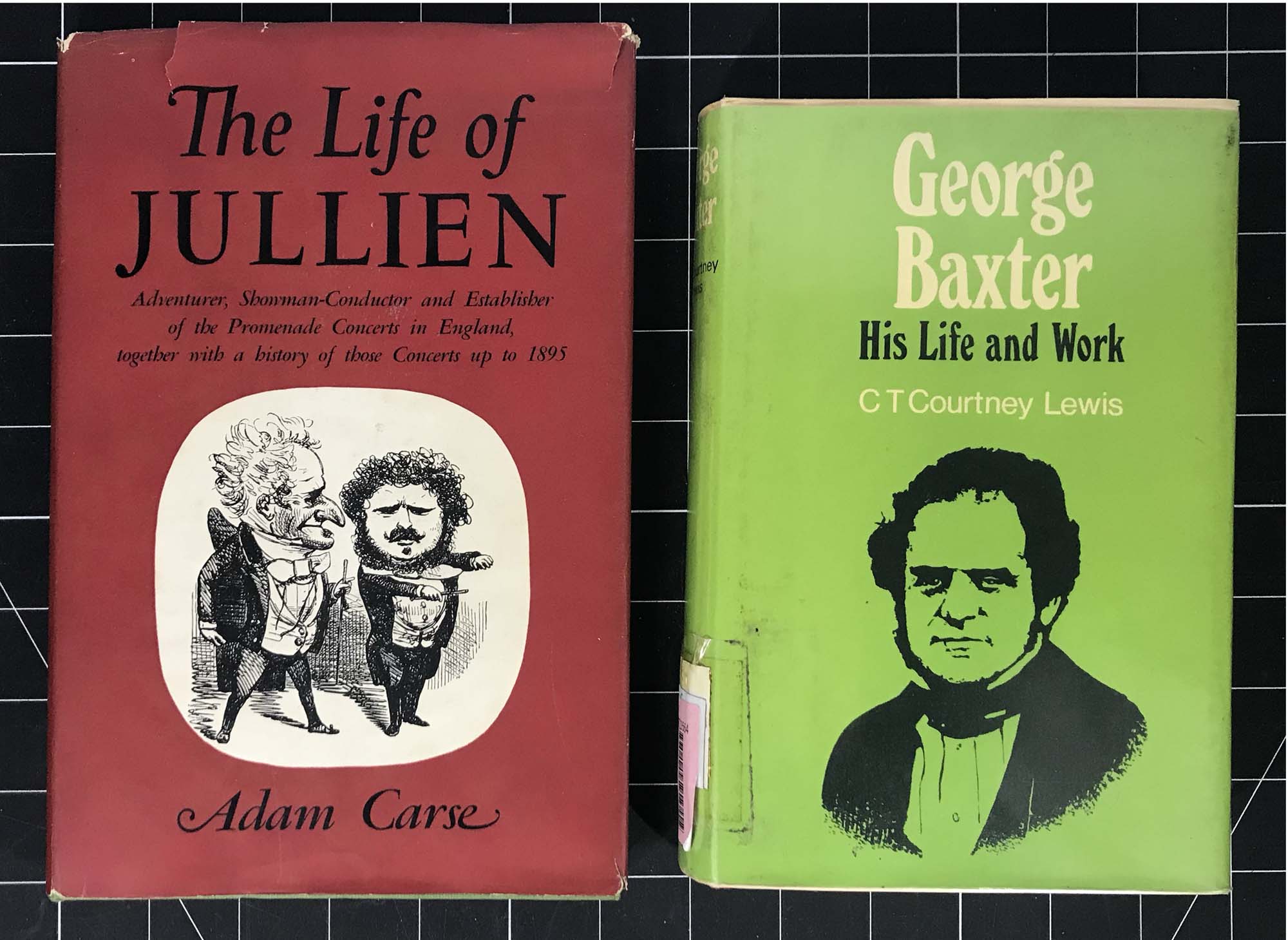
The Life of Jullien by Adam Carse, W. Heffer & Sons, Cambridge, 1951.
George Baxter: His Life and Work, by C. T. Courtney-Lewis, Republished by EP Publishing, 1972; First published London, 1908.
 The Life of Jullien by Adam Carse, W. Heffer & Sons, Cambridge, 1951.
Men of the cusp
Jullien’s father was a bandleader, Baxter’s a printer and publisher. Generational family business had been the traditional model, but it was withering under the onslaught of factories and mass production. These two men, broadly versed in the tools of their trade from an early age, had a grand perspective that enabled them to seize the opportunity, offered by industrialization, of creating a mass market for their cultural products, straddling the worlds of high art and popular taste.
Jullien, with his graphically arresting sheet music and immersive concerts, performed at scale with the latest instruments—saxophone, ophicleide, cornopean, concertina, euphonium, clavicor, valve cornet, etc.
And Baxter with his glorious colour—sharp and shiny as a daguerrotype.
Prior to the 1840s, a run of best-selling sheet music was 1,000 copies; for Jullien a decade later it was 100,000. Popular prints of the Regency era by such as Rowlandson, Gillray and Cruikshank also had small editions, typically 500; these were hand-coloured (piece work) and sold for around three shillings. It was Baxter’s great innovation to automate the process of colouring, by wood blocks, increasing the quantity of a print’s reproduction a thousandfold.
Both men introduced the luxury of fine art, previously a preserve of the aristocracy, to the vast middle and lower classes. ●