

A HISTORY OF REPRODUCTION
Delving into “Rodin’s Last Sculpture,” a bizarre relic fraught with meaning
Certain images have been iterated over the years, acquiring the patina of age as they preserve the trace of obsolete technologies, extinct skills and bygone aesthetics. Step by step, through many hands in many media and devices, the subject here, ostensibly a sculpture by Auguste Rodin although just as much a photograph by Al Wyatt, has been transformed. It persists as icon, trite but true.
Let’s unpack the layers from last to first, although alternatively you may scroll down to #1 and proceed upwards in chronological sequence. (Or go further down for the juicy bits.) Bear in mind that the visual form of each of these stages of reproduction involves an artisan/artist and a specific piece of equipment.
16 Image on a digital screen (above)
Unlike previous renderings the digital image is not fixed in any particular medium other than raw data, which is invisible. The image is malleable, capable of being viewed on various devices according to user preferences and the decisions of hardware manufacturers, software engineers and interface designers. Notably, the whole image cannot be seen in full detail on a mobile phone, although the viewer may magnify parts by “pinch-to-zoom.”
15 Photoshop file from camera shot of book page
The camera exposure has been tweaked, cropped square and sized for the FontLife blog, which is designed in WordPress for the Shinntype site.
14 Photo of book page
This is the photo I styled, lit and shot for this essay, of a page from Purposes of Art by A. E. Elsen.
13 Printing of book page
Rendered in dense black ink from a gravure plate by the Presses Centrales, Lausanne, Switzerland, on smooth uncoated matte cream stock. Ironically, despite not being printed “in full colour” it’s better than that, as the subject is monochrome and no process for greyscale is richer and sharper than photogravure.
12 Exposing and developing the printing plate
Done from a composite of negatives combining text and image, through a high resolution halftone screen.
11 Filmstripping together of negatives
Made from art board negative (layout and text) with picture negative in position.
10 Process photography of visual content
High contrast negative made from art board assembly, and full tone negative from supplied glossy photographic print of sculpture, to size.
9 Design of book format and page
Purposes of Art by Albert E. Elsen, Holt, Rinehart and Winston, New York, 1972, 8½”x 10”, designed by Marlene Rothkin Vine. Specific picture size and cropping, and layout of whole page including type spec: Times Roman 10/11 pt.
8 Print of sculpture photo from film negative
Likely a silver bromide ‘glossy,’ 8”x 10”.
7 Studio shot of sculpture
Composition, background, lighting and film exposure by Al Wyatt, staff photographer at Philadelphia Museum of Art.
6 Assembly of the sculpture
The two components would have been shipped from France and no doubt assembled by a curator in the USA according to instruction.
5 Casting the hand
Mould made from life, with plaster cast touched up to remove artefacts of said casting.
4 Casting the torso
A plaster copy was made of the torso, to match the medium of the hand.
3 Striking a pose
Rodin created a hand shape suitable for casting from life, to support the small torso sculpture as if holding it.
2 The concept imagined
A sculpture: Rodin’s right hand holding a small torso made by that hand. The hand to be cast from life by his assistant Paul Cruet.
1 Rodin sculpted a small torso
A maquette perhaps, for a larger work, or just experimenting.
A brief summary
As Rodin, incapacitated by a stroke at age 77, approached death in 1917, the vultures circled, raiding his studio. Those entrusted with his care denied him pen and paper to sketch with, for fear of being excluded from a new will. His assistant Paul Cruet made a cast of the great man’s hand, to hold a small maquette. Once attributed to Rodin (by Elsen amongst others), the piece is now considered Cruet’s fabrication.
Rodin had spent many years as a journeyman artisan, success coming belatedly at age 37 with the statue The Age of Bronze, the notoriety of which was fueled by those who accused it of being cast from life. His genius was undeniable, even to those who did not appreciate transgressive art. His work emerged as controversial, debated for its non-traditional poses, coarse and virile treatment of male figures and the eroticism of female nudes. Meanwhile, his powers of seduction and the trail of lovers were well known, as was the disastrous affair with a teenage sculptress half his age.
Many of his figures were missing body parts, alluding to statues dug up from Antiquity which, because of lost extremities, had become provocative through the ravages of time: the armless Venus de Milo, the headless Winged Victory of Samothrace, etc. Departing from naturalism was another way he asserted his status, as if to say, “this is great art, not merely a dead snapshot of life.”
And that, the contrast between hand-made art (with overtones of distressed antiquities) and lifeless mechanical reproduction, is what The Artist’s Hand Holding a Torso signified, a summary of Rodin’s oeuvre and attitude. It was a banal concept bizarrely and grotesquely executed, but nonetheless on point, with the subtext of the old satyr fondling a kinky fetish of a lifetime obsession. But what of The Burghers of Calais, Balzac and The Thinker? Those awesome achievements eluded this facile eulogy.
 Torso of a Young Woman, Auguste Rodin, 1909. Bronze, 99 x 45 x 30 cm.
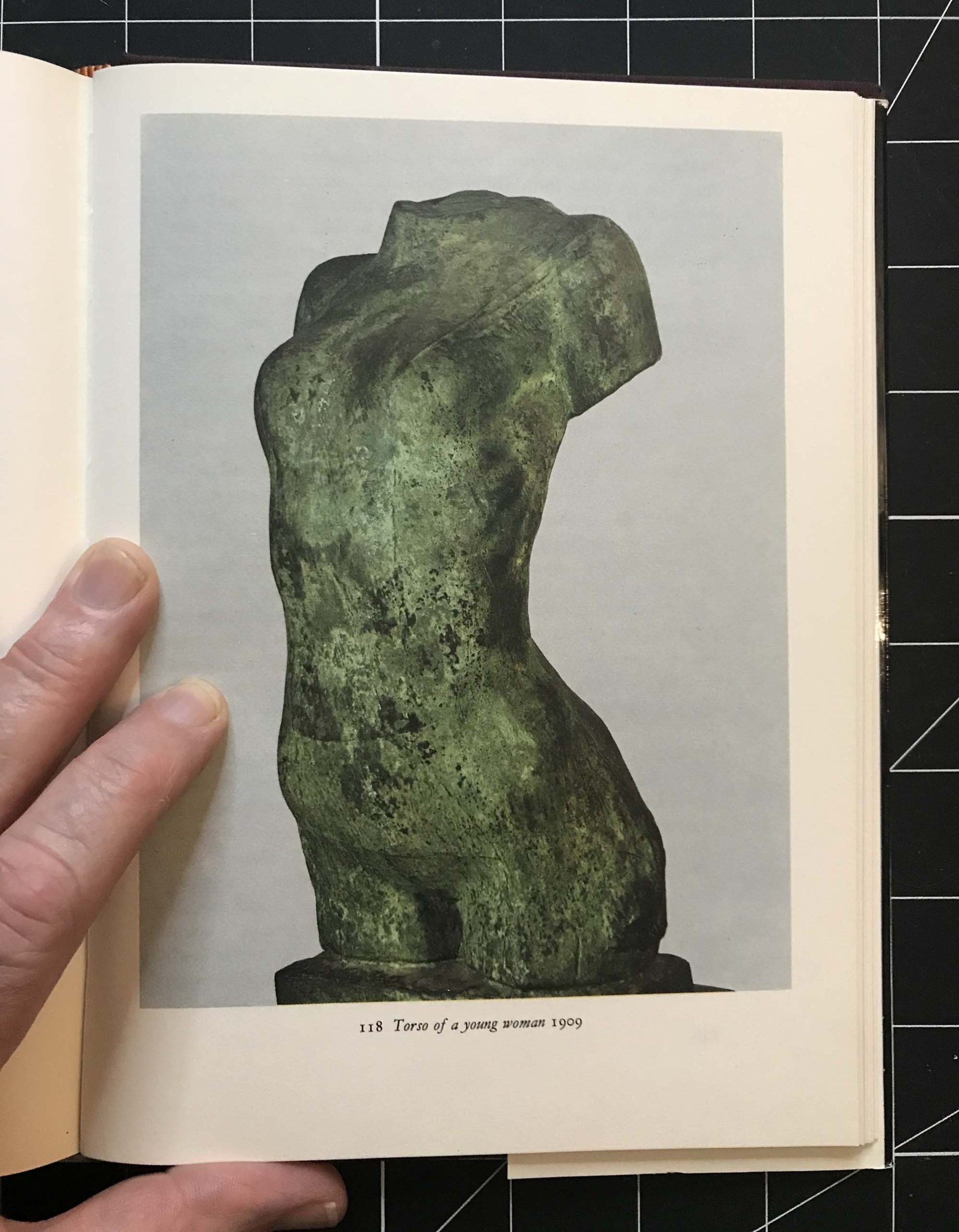 Torso of a Young Woman, Auguste Rodin, 1909. Bronze, 99 x 45 x 30 cm.
The quality of this influential work, life size, is of a different order to that of Cruet’s assemblage. ●